
Your X-ray may reveal an old spinal injury you never knew you had!
Have you ever had an X-ray or MRI of your back and noticed the words Schmorl’s node in the report? The name may sound alarming, but there’s usually no reason to worry.
In fact, Schmorl’s nodes are extremely common, with some studies finding them in more than half of adults. Most people who have them don’t even know they’re there!
But here’s what makes a Schmorl’s node interesting: Although the node itself is usually painless, it can be a clue that your spine has experienced significant stress or an injury at some point in your life.
What Exactly Is a Schmorl’s Node?
Your spine is made up of bones called vertebrae, with soft, cushion-like discs between them. These discs act as shock absorbers, helping your back handle the stresses of everyday movement.
Most people have heard of a herniated disc, where part of the disc pushes outward and may irritate a nearby nerve.
A Schmorl’s node is different.
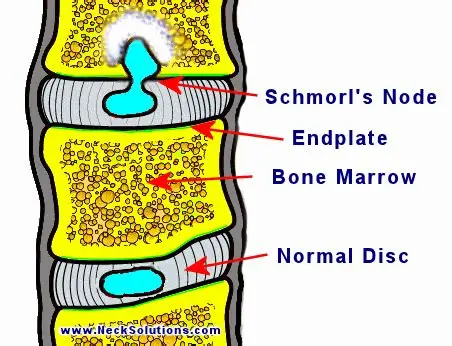
Instead of pushing outward, part of the disc pushes upward or downward into the bone of the vertebra above or below it, through a weakened or damaged surface called the endplate.
Think of pressing your thumb into a piece of Styrofoam. The pressure leaves a small indentation. A Schmorl’s node creates a somewhat similar impression in the spinal bone.
If Schmorl’s Nodes Don’t Hurt, Why Should You Care?
This is the most important part!
Most Schmorl’s nodes are painless, especially after the area has healed. But the presence of a node can tell us something important about what your spine has experienced.
A Schmorl’s node may develop following a sudden injury, such as a hard fall, an awkward landing, or excessive pressure on the spine. It can also develop gradually from years of repetitive stress, changes in the spinal discs, or weakening of the bone.
In other words, the node may be a lasting reminder of an injury or stress that occurred years ago, even if you don’t remember the event.
And here’s the key: Just because the Schmorl’s node doesn’t hurt doesn’t mean the rest of your back is functioning properly.
The same forces that contributed to the node may also have affected the surrounding joints, muscles, ligaments, and discs.
For example, imagine falling hard on your backside years ago. The impact may have damaged a spinal endplate, eventually leaving a Schmorl’s node. Although the bone heals and the node becomes painless, you may still have stiffness, restricted joint movement, or altered muscle function associated with that injury.
That is why it’s important to look beyond the X-ray and evaluate how your entire spine is functioning.
Can a Schmorl’s Node Ever Be Painful?
Yes, but it’s less common.
When a Schmorl’s node first develops, particularly following an injury, it can cause inflammation and swelling within the spinal bone. This may produce a deep ache in the back, especially with bending, lifting, or twisting.
However, once the inflammation settles and the area heals, most nodes become painless.
If you have back pain and an X-ray reveals a Schmorl’s node, don’t automatically assume the node is causing your pain.
It may simply be evidence of an old injury, while your current discomfort comes from restricted spinal joints, irritated muscles, other disc problems, or an entirely different source.
How Can Chiropractic Care Help?
At Performance Health Center, we believe that finding the source of your pain is more important than simply treating what appears on an X-ray.
A Schmorl’s node may be painless, but it can provide a valuable clue about the stresses your spine has experienced.
A thorough chiropractic examination looks at how your spinal joints move, how your muscles function, your posture, and whether certain areas of your back are under excessive stress.
Depending on the findings, treatment may include gentle joint mobilization, appropriate chiropractic adjustments, soft-tissue therapies such as Active Release Techniques (ART), and specific exercises to improve spinal stability and movement.
The goal is not to eliminate the Schmorl’s node itself. In most cases, the node is a permanent structural change that doesn’t need to be repaired.
Instead, our goal is to identify and address any remaining problems in spinal function that may be contributing to your discomfort.
Treatment must always be appropriate for the individual, particularly if the node is associated with a recent injury, bone swelling, or weakened bones.
Five Exercises That May Help Keep Your Spine Healthy
Maintaining good spinal mobility and strong supporting muscles can help your back better tolerate everyday stresses.
Some helpful exercises include:
- Child pose: Gently stretches the muscles of your lower back.
- Cat/Cow: Encourages comfortable movement and flexibility throughout your spine.
- Bird-Dog: Strengthens the muscles that stabilize your back.
- Planks (Front & Side): Build core strength to support your spine.
- Bridges: Strengthen your gluteal muscles, which play an important role in supporting your lower back.
Not every exercise is appropriate for every spinal condition. If you have a recent injury or experience pain with these movements, consult your healthcare provider before continuing.
The Bottom Line: Don’t Just Look at the Node. Look at the Whole Spine!
A Schmorl’s node is usually nothing to fear. Most are painless and require no treatment.
But it may be an important clue that your spine has experienced trauma, repetitive stress, or structural weakening at some point in your life.
The node itself may have healed long ago, but that doesn’t necessarily tell us whether your spine is moving and functioning as well as it should.
And that’s why we believe in looking at the whole person, not just the X-ray.
Remember: An X-ray shows us what your spine looks like. A thorough examination helps us understand how your spine actually works.
For more information or to schedule an evaluation, email Dr. Jay Atwi at DrJayAtwi@performancehealthcenter.com.